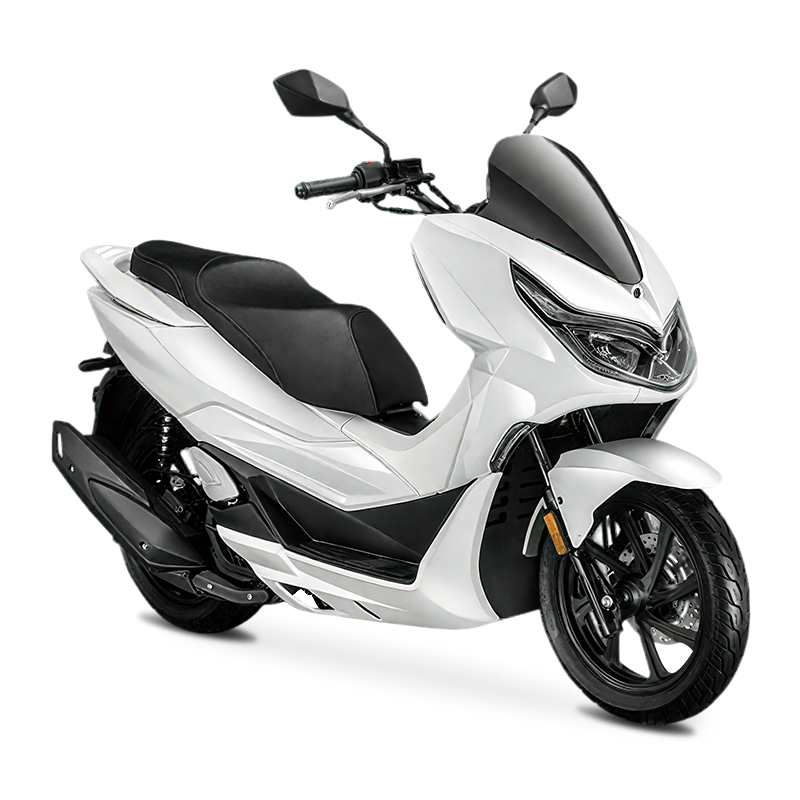
1. Why Is the Water Cooled Single Cylinder Scooter Motorcycle Becoming More Common in Factory Production?
(1) Stability in high-temperature environments
Manufacturers value the Water Cooled Single Cylinder Scooter Motorcycle because its cooling system maintains engine temperature more steadily than basic air-cooled designs. This reliability is especially meaningful for riders in warm climates or those who use scooters for continuous commuting.
(2) Engineering opportunities for smoother performance
To refine the Water Cooled Single Cylinder Scooter Motorcycle, factories adjust coolant channels, pump capacity, and radiator placement. These adjustments help reduce vibration and improve throttle response, which importers often request for models intended for urban and suburban riders.
(3) Growing export potential
The Water Cooled Single Cylinder Scooter Motorcycle is favored in markets that expect consistent performance during longer travel distances. Manufacturers therefore design these units with improved sealing, durable hoses, and stable mounting brackets to ensure long-term reliability across different regions.
2. What Makes the 150 Water Cooling Scooter Motorcycle Moped an Important Mid-Displacement Category?
(1) Power suited for daily and mixed-route usage
A 150 Water Cooling Scooter Motorcycle Moped offers a balanced power level for riders who want confident acceleration without moving into larger motorcycle classes. Manufacturers strengthen this category by tuning engines to maintain smooth output on both crowded streets and short highway segments.
(2) Efficient thermal management for durability
To support longevity, factories equip the 150 Water Cooling Scooter Motorcycle Moped with compact radiators, reinforced coolant tubes, and thermostatic controls. These engineering measures reduce thermal stress on internal components, enabling consistent operation throughout various commuting conditions.
(3) Versatility for international distributors
Importers appreciate the 150 Water Cooling Scooter Motorcycle Moped because it adapts well to countries where riders use scooters for both personal mobility and light commercial tasks. Factories address this diversity by offering models with different storage layouts, body materials, and fuel-system settings.
3. Why Are Manufacturers Increasing Their Investment in the Liquid Cooling Motorcycle Category?
(1) Managing engine performance across wide temperature ranges
A Liquid Cooling Motorcycle provides steady operating temperatures, which supports predictable output during long-distance travel or heavy urban traffic. Manufacturers refine coolant circulation patterns and radiator design to keep heat distribution stable, especially for engines with higher compression.
(2) Advantages in noise and vibration reduction
To enhance the feel of a Liquid Cooling Motorcycle, factories use coolant-based systems to lower mechanical noise and reduce metal expansion during operation. These features contribute to a smoother riding experience, which many distributors consider valuable when selecting models for commuter markets.
(3) Compatibility with multiple engine types
A Liquid Cooling Motorcycle system can be used in scooters, sport models, and touring units. This compatibility allows factories to standardize certain components—such as pumps, gaskets, and radiator mounts—across different platforms, improving assembly efficiency while still offering varied performance levels.
4. How Do These Water-Cooled Categories Influence Overall Manufacturing Trends?
(1) Rising focus on engine longevity
The rise of the Water Cooled Single Cylinder Scooter Motorcycle encourages factories to analyze coolant flow, thermal cycles, and sealing materials. These insights later benefit other engine families in the manufacturer's lineup.
(2) Mid-range market expansion
Demand for the 150 Water Cooling Scooter Motorcycle Moped pushes factories to develop flexible production lines capable of adjusting output for different displacement ranges, allowing importers to tailor their orders more precisely.
(3) Wider adoption of cooling technology
As the Liquid Cooling Motorcycle becomes more common in global markets, factories integrate standardized cooling components throughout various models, supporting smoother maintenance and consistent technical documentation for distributors.
How Do These Segments Shape the Industry?
The rising importance of the Water Cooled Single Cylinder Scooter Motorcycle, the practical performance of the 150 Water Cooling Scooter Motorcycle Moped, and the expanding role of the Liquid Cooling Motorcycle reveal how manufacturers respond to demands for durability, stability, and improved riding comfort. Together, these categories reflect an industry steadily enhancing its engineering approach as global riders place more value on efficient thermal management and smooth everyday operation.


 English
  中文简体
中文简体 русский
 Español
 عربى
عربى